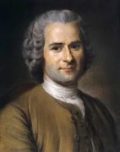
Rick’s unpublished mid-1970s paper on Jean Jacques Rousseau’s philosophy concludes that it “constitutes a coherent system …. but conceals a host of difficulties”.
Rick summarises Rousseau’s philosophy in five propositions:
“1. Humans are social beings and historical beings.
2. Reason arises in the historical development of human reality and initially plays a divisive role in society.
3. Parallel to the development of divisive reason is the development of social interdependence: “Our needs bring us together in proportion as our passions divide us, and the more we become the enemies of our fellows, the less we can do without them” (Ch 2 Geneva Manuscript of SC, 0C3 282).
4. Social division and dependence is embodied in the institution of private property.
5. Reason contains the possibility of utilising the factual interdependence to develop a sense of unity and a universal General Will, which involves real individual freedom and social harmony.
To which may be added as a sixth proposition the pessimistic conclusion that:
6. But this remains only a theoretical possibility since the existing social institutions reinforce the divisive aspects of reason, rather than its unifying potential.
I think it is obvious merely from reading these propositions that they contain the central ideas of Kantian ethics, and of Hegel’s dialectic, while Marx offers a way out of the dilemma posed by the sixth proposition. These writers, and Sartre after them, merely refine and elaborate Rousseau’s essential insights, and the best way, perhaps, to test their validity is to see how successfully these writers do manage to do this. This will involve a study of the philosophical methods underlying the theory, since this method is also made more explicit in the later philosophers. Thus in showing the development of the theory I shall at the same time be discussing its claim to truth, and at the end of the study I shall attempt to analyse the problems left outstanding.” (p 28 of original manuscript).
The last paragraph above shows that Rick sees Rousseau as signposting the way for later continental philosophers.
And that Rousseau provides the starting point for Rick’s own study of philosophical methods which would occupy him from the mid-1970s onwards. Rick had hoped to continue this project in Germany. But he was not allowed to leave South Africa to take up his Humboldt scholarship. Although Rick didn’t live to complete his project, there are substantial papers here from which we can understand much of Rick’s thinking.


